

10 Proven Strategies to Crush Your ACS General Chemistry Study Guide and Pass with Confidence

Struggling with the ACS General Chemistry exam? This expert ACS general chemistry study guide covers every topic, strategy, and mistake to avoid so you can score higher and stress less.
Introduction
You’ve put in the hours. You’ve watched the lectures, taken the notes, and done the homework. But then you hear two words (ACS exam) and suddenly your stomach drops.
You’re not alone. The ACS General Chemistry exam is notoriously challenging, covering everything from atomic structure to thermodynamics in one tightly timed test. It’s the kind of exam that humbles students who thought they understood chemistry and rewards those who studied smart, not just hard. This comprehensive ACS general chemistry study guide is built specifically to help you do exactly that.
Whether you’re sitting for the ACS exam at the end of your first or second semester of general chemistry, or you’re a pre-med student trying to boost your score, this ACS general chemistry study guide gives you a clear, actionable roadmap. We’ll cover every major topic, show you how to work efficiently under pressure, point out the classic mistakes that cost students points, and give you expert-level tips that most online materials simply don’t include.
What Is the ACS General Chemistry Exam?
The ACS General Chemistry exam is a standardized test developed by the American Chemical Society (ACS) Division of Chemical Education. It’s used by universities across the United States as a final assessment in first-year general chemistry courses. If you are using an ACS general chemistry study guide to prepare, you already know how massive the syllabus can feel.
What makes it different from a regular professor-written exam? It’s nationally normed. Your score is reported as an ACS exam scoring percentile (meaning you’re not just graded against your classmates, but against thousands of chemistry students across the country). That changes everything about how you should prepare using a structured general chemistry study plan and a reliable ACS general chemistry study guide.
- Multiple-Choice Only: There is no partial credit or “showing your work” points.
- Equal Weightage: Every question carries the same weight.
- Conceptual Focus: The test is specifically designed to evaluate conceptual understanding, which is why a targeted ACS general chemistry study guide is so critical.
Note: Many students walk in having memorized every equation and still find themselves struggling because they don’t understand the structural “why” behind the chemistry—a common pitfall we address throughout this ACS general chemistry study guide.
Exam Format and Scoring Breakdown
Understanding the ACS chemistry exam format before you sit down to study is critical. Here’s what the standard national test looks like, as detailed in the official ACS general chemistry study guide parameters:
- Number of Questions: 70 multiple-choice questions (some exam variants range between 60 to 80).
- Time Allowed: 110 minutes (allots roughly 1.5 minutes per question).
- Sections: Two parts (often split systematically between Part 1 for first semester topics and Part 2 for second semester topics).
- Formula Sheet: Provided, but highly minimal (usually containing just a basic periodic table and a few fundamental constants).
- Scoring Matrix: Raw score converted directly to a national percentile.
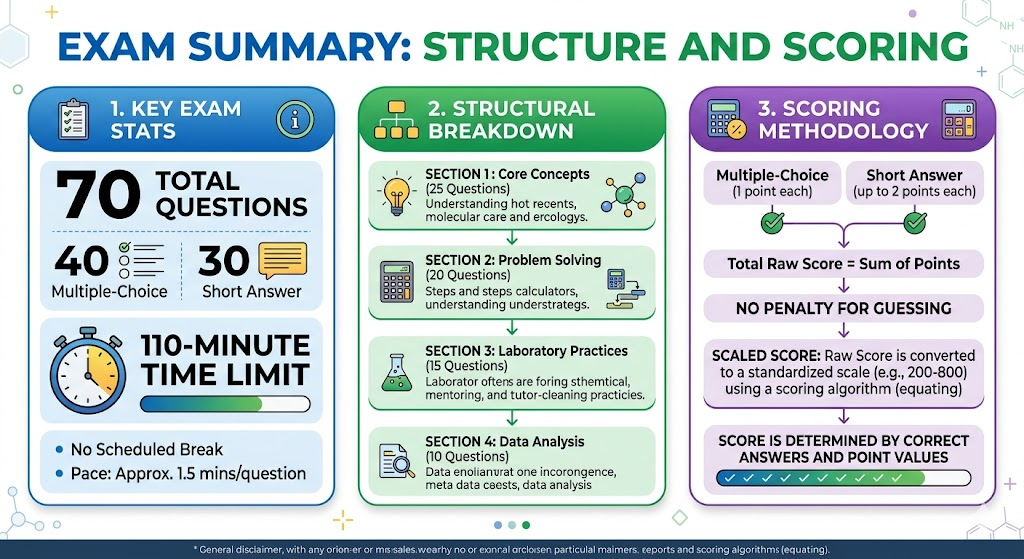
There is typically no penalty for wrong answers, so always guess if you’re unsure. Never leave a bubble blank on your answer sheet. The national average score usually falls around the 50th percentile, with many programs requiring students to score at the 25th percentile or higher to pass. Competitive pre-med tracks often expect the 50th percentile or above.
Core Topics You Must Master
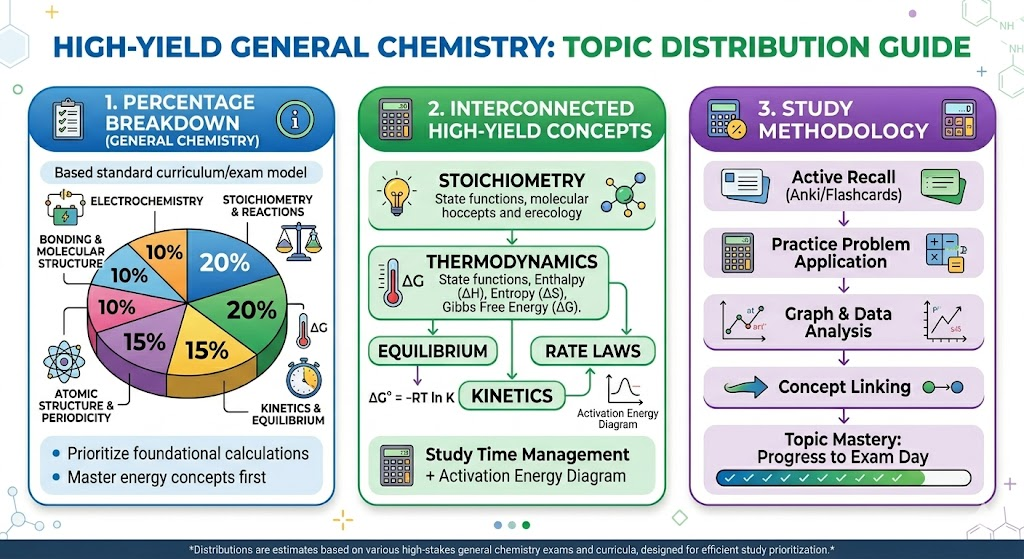
The exam covers an extensive array of foundational concepts. Based on the standard ACS exam topic breakdown, here are the high-priority areas you need to target using your ACS general chemistry study guide.
Atomic Structure and Periodic Trends
- Electronic configuration and orbital notation.
- Quantum numbers ($n, l, m_l, m_s$).
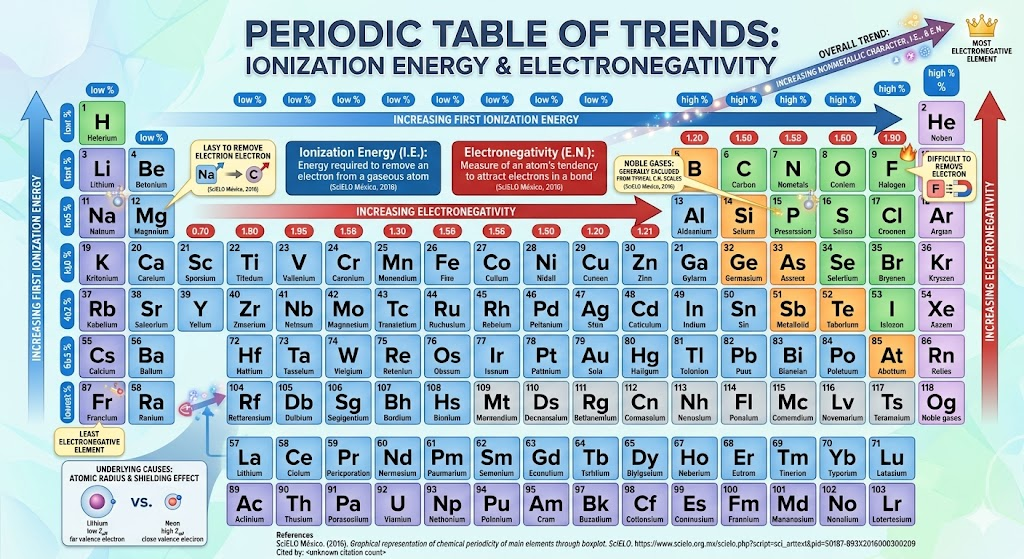
- Periodic trends: electronegativity, atomic radius, ionization energy, and electron affinity.
- Understanding the underlying coulombic forces explaining why these trends exist rather than just memorizing chart arrows.
Bonding and Molecular Structure
- Comic vs. covalent bonding character.
- Lewis structures and calculating formal charge via:$$\text{Formal Charge} = \text{Valence } e^- – \left(\text{Non-bonding } e^- + \frac{1}{2}\text{Bonding } e^-\right)$$
- VSEPR theory and predicting molecular geometry.
- Polarity, resonance structures, and dipole moments.
- Orbital hybridization types ($sp, sp^2, sp^3, sp^3d, sp^3d^2$).
Stoichiometry and Chemical Reactions
This stands out as one of the highest-weight sections on the ACS exam topics list. Any complete ACS general chemistry study guide will tell you to expect multiple calculation questions regarding:
- The mole concept and applying Avogadro’s number ($6.022 \times 10^{23} \text{ mol}^{-1}$).
- Empirical and molecular formulas.
- Identifying the limiting reagent and calculating percent yield.
- Balancing complex molecular equations, including redox reactions.
Gases
- Ideal Gas Law ($PV = nRT$) and understanding when real gases deviate under high pressure and low temperature.
- Combined Gas Law and Dalton’s Law of Partial Pressures ($P_{\text{total}} = P_1 + P_2 + P_3 + \dots$).
- Graham’s Law of effusion rate calculations:$$\frac{\text{Rate}_1}{\text{Rate}_2} = \sqrt{\frac{M_2}{M_1}}$$
- Kinetic Molecular Theory axioms.
Solutions and Colligative Properties
- Concentration metrics: Molarity ($M$), molality ($m$), and mole fraction ($\chi$).
- Henry’s Law governing gas solubility.
- Colligative properties: Boiling point elevation ($\Delta T_b = i K_b m$), freezing point depression ($\Delta T_f = i K_f m$), and osmotic pressure ($\Pi = iMRT$).
- Basic aqueous solubility rules.
Thermodynamics and Thermochemistry
- Comprehensive relationships between Enthalpy ($\Delta H$), Entropy ($\Delta S$), and Gibbs free energy ($\Delta G = \Delta H – T\Delta S$).
- Applying Hess’s Law to multi-step reactions.
- Calorimetry calculations ($q = m c \Delta T$).
- Standard heats of formation ($\Delta H_f^\circ$).
Equilibrium
- Writing and interpreting equilibrium expressions ($K_c$ and $K_p$).
- Predicting system shifts using Le Chatelier’s Principle.
- Interpreting the relationship between the reaction quotient ($Q$) and the equilibrium constant ($K$).
- Setting up algebraic ICE (Initial, Change, Equilibrium) tables.
Acids and Bases
- Brønsted-Lowry and Lewis acid-base definitions.
- Calculating $pH$, $pOH$, $K_a$, and $K_b$.
- Buffer solutions and applying the Henderson-Hasselbalch equation:$$pH = pK_a + \log\left(\frac{[\text{A}^-]}{[\text{HA}]}\right)$$
- Interpreting acid-base titration curves.
Electrochemistry
- Assigning oxidation states and balancing redox pathways.
- Galvanic or Voltaic cells setup and identifying components (anode vs. cathode).
- Standard reduction potentials ($E^\circ$) and the Nernst Equation:$$E = E^\circ – \frac{RT}{nF}\ln Q$$
- Electrolysis metrics.
Kinetics
- Determining differential rate laws and reaction orders.
- Utilizing integrated rate laws (zero, first, and second-order systems).
- Half-life formulas ($t_{1/2}$), the Arrhenius equation, and activation energy ($E_a$).
How to Build an Effective Study Plan
One of the biggest reasons students underperform on the standardized test is that they don’t utilize structured college chemistry study strategies. They open a random textbook chapter and read passively instead of following a systematic ACS general chemistry study guide routine. Here is how to execute a proper general chemistry study plan:
Step 1: Take a Diagnostic Test First
Before reviewing concepts, take a full-length, timed practice test. This highlights your true baseline. An effective ACS general chemistry study guide strategy requires hard data showing your weak spots.
Step 2: Divide and Prioritize
Categorize every major chemistry domain into three practical buckets based on accuracy:
- Strong (80%+ accuracy): Review briefly to maintain recall.
- Developing (50% to 80% accuracy): High-leverage target area. Focused practice problems here yield the fastest score increases.
- Weak (Below 50% accuracy): Demands deep-dive concept rebuilding via your ACS general chemistry study guide notes.
Step 3: Study in Blocks, Not Marathons
Cognitive science consistently demonstrates that spaced, focused review blocks outperform long, exhaustive cramming sessions. Use a modified Pomodoro technique: study intently for 45 minutes, followed by a strict 10-minute break.
Step 4: Practice Under Exam Conditions
At least two weeks prior to test day, transition to solving ACS chemistry practice questions under a strict 1.5-minute-per-question limit.
Best Study Resources for ACS Chemistry
When tracking down the best resources for ACS general chemistry study guide platforms, focus on high-yield materials:
- ACS Official Exam Prep Guide: Published directly by the ACS Division of Chemical Education via
store.acs.org. It contains retired exam questions and remains the single most accurate practice utility available. - Your Course Textbook: Standard volumes like Chemistry: The Central Science are excellent for step-by-step conceptual troubleshooting.
- Khan Academy Chemistry: An excellent, free visual tool for mastering tricky thermodynamic equilibrium concepts.
- ChemLibreTexts: A comprehensive open-access resource available at
chem.libretexts.org, ideal for cross-referencing formula derivations. - Anki Flashcards: Uses spaced-repetition algorithms to streamline memorization of polyatomic ions and solubility rules.
Expert Study Strategies That Actually Work
Master the Concept First, Then the Formula
Most test questions evaluate conceptual models rather than raw computation. As emphasized in any expert ACS general chemistry study guide, you must understand the structural reason behind reactions rather than just plugging numbers into an equation.
Eliminate Wrong Answers Strategically
Distractors on standardized tests are intentionally designed to mirror common algebraic errors. If you can systematically disprove and eliminate two options based on periodic trends or signs, your statistical odds of a correct guess jump from 25% to 50%.
Use Dimensional Analysis for Every Calculation
Always explicitly write out your units during practice. The exam regularly places distractors that differ solely by a factor of 10 or a metric conversion error (such as Joules vs. Kilojoules). Tracking your units explicitly prevents these errors.
Don’t Skip the Obscure Topics
Many students focus exclusively on major pillars like stoichiometry while completely skipping minor topics like nuclear chemistry kinetics. A premium ACS general chemistry study guide will always remind you that missing out on these straightforward point opportunities can heavily lower your final percentile.
Common Mistakes Students Make (And How to Avoid Them)
- Mistake #1: Passive Review Patterns: Reading highlighted notes gives an illusion of competence. Active recall via unassisted practice problems from an ACS general chemistry study guide is far more effective.
- Mistake #2: Disregarding Significant Figures: Standardized answer options are highly precise. Mixing up basic rules regarding significant figures can cause you to select a structurally incorrect distractor.
- Mistake #3: Memorization Without Context: Memorizing isolated values without realizing what those constants signify fails when encountering multi-variable conceptual questions.
- Mistake #4: Skipping Error Analysis: Marking a practice problem wrong and moving on immediately is a missed opportunity. Spend five minutes analyzing your exact misstep to rewire your problem-solving process.
- Mistake #5: Starting the Week of the Exam: The test covers two full semesters of foundational material. Attempting to digest this volume of information in 48 hours is ineffective. For optimal results, check out our comprehensive roadmap on how to study for ACS general chemistry exam in 2 weeks.
Pros and Cons of ACS Exam Prep Approaches
Approach 1: Self-Study with the Official ACS Guide
- Pros: Features actual retired exam items; highly self-paced and cost-effective.
- Cons: The basic print layout lacks thorough diagnostic feedback for wrong answers.
Approach 2: University Tutoring and Review Sessions
- Pros: Immediate access to specialized academic advice and structural peer accountability.
- Cons: Sessions are often scheduled very close to finals week, leaving little room for self-directed correction using a personalized ACS general chemistry study guide.
Approach 3: Dedicated Online Video Platforms
- Pros: 24/7 asynchronous access; visual animations assist in understanding abstract molecular orbitals.
- Cons: Highly prone to turning into passive watching without supplementary active text problem-solving.
Expert Tips Section
These are the strategies that high-scoring students and veteran chemistry instructors rarely share openly:
Tip 1: Treat the Periodic Table as an Active Tool. Top scorers don’t just look up molar masses; they use group positions to instantly predict relative ionic size, effective nuclear charge ($Z_{\text{eff}}$), and expected molecular geometries.
Tip 2: Work Backwards from Answer Choices. For complex equilibrium or stoichiometry questions, plugging given multiple-choice values directly back into the simplified expression can often yield the correct option much faster than setting up an expansive quadratic calculation.
Tip 3: Leverage Color-Coded Structural Notes. Create visual associations by assigning uniform colors to distinct chemical domains to streamline your visual memory recall under pressure.
Tip 4: Reverse-Engineer the Test by Writing Questions. Draft 5 original multiple-choice questions per major topic area along with deliberate distractors, then swap them with a peer. This forces you to think like the test designer.
Tip 5: Consolidate Memory via Sleep. Sacrificing sleep to cram until 3:00 AM hurts your score. Neurological memory consolidation happens during deep sleep phases; getting 7 to 8 hours of rest before your test is statistically a better variable for success.
FAQs About the ACS General Chemistry Exam
Q1: What is a good score on the ACS General Chemistry exam?
A solid score generally sits at or above the 50th percentile nationally. Competitive engineering or pre-med tracks look for scores hitting the 70th percentile and above. Because the test is nationally normed, the raw score requirements shift slightly between versions, but correctly bubbling 50 to 55 out of 70 questions typically secures a spot in the upper tier. For more specialized recommendations tailored to your goals, you can look up specific program thresholds.
Q2: Is the ACS General Chemistry exam hard?
Yes. It is traditionally more rigorous than regular class exams because it evaluates wide-ranging conceptual application rather than simple plug-and-chug math. Students who focused strictly on surface-level memorization throughout the term often find it difficult, whereas those who focused on foundational principles adapt much easier. This is why following a dedicated ACS general chemistry study guide is highly recommended.
Q3: How long should I study for the ACS exam?
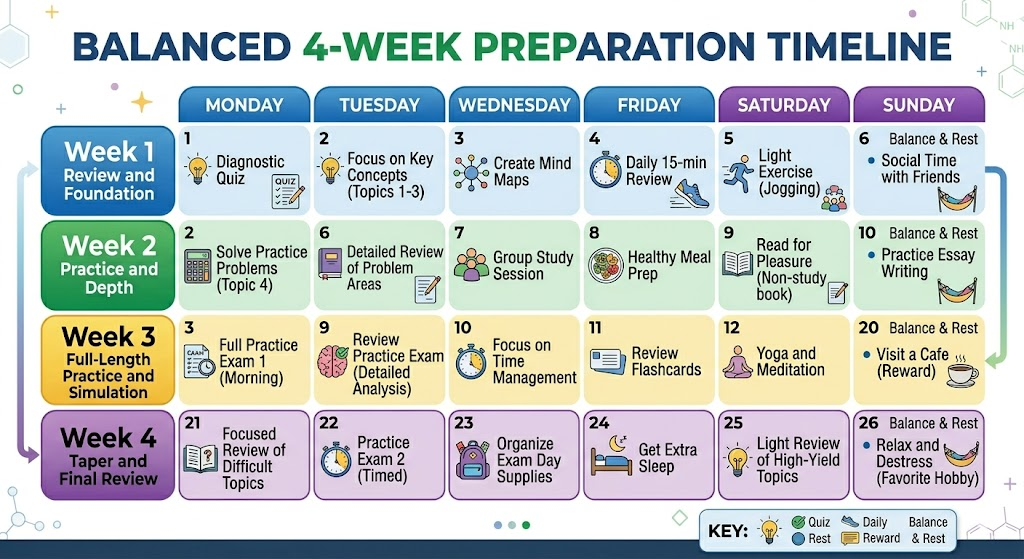
Most students require 2 to 4 weeks of structured, daily preparation for roughly 1 to 2 hours per day. If your underlying coursework comprehension is stable, a target plan following guidelines on how to study for ACS general chemistry exam in 2 weeks is completely viable. If major gaps remain, give yourself 4 full weeks.
Q4: Does the ACS exam use a formula sheet?
You receive a highly limited reference sheet that contains a standard periodic table along with basic universal constants (such as the ideal gas constant $R$, Avogadro’s number, and Faraday’s constant $F$). Comprehensive formula maps are not provided, meaning you must know core equations from memory.
Q5: Can I use a calculator on the ACS exam?
This depends entirely on your university’s local policy. While some departments permit a basic, non-programmable scientific calculator, others enforce a strict no-calculator policy. Always verify your specific instructor’s guidelines well in advance.
Final Verdict / Conclusion
The ACS General Chemistry exam is undeniably a rigorous academic milestone, but it is entirely manageable with the right approach. High scores are driven by the quality of your preparation, not simply the total hours logged. Conceptual comprehension beats rote memorization, a structured study timeline beats late-night cramming, and an authentic ACS general chemistry study guide gives you the edge you need.
Start your review early, confront your weak spots directly, and practice under realistic pacing limits. You have built the foundation, now use this ACS general chemistry study guide to execute your plan with confidence.