

Are Gambling Losses Tax Deductible? The Ultimate 2026 IRS Guide for Players

Are gambling losses tax deductible? Master the IRS rules and learn why gambling losses capped to gambling winnings is the golden rule for your 2026 tax return.
Are Gambling Losses Tax Deductible? The Ultimate 2026 IRS Guide
Attention: Tax season is the ultimate “reality check” for every gambler. Whether you’ve spent the year hitting the slots, betting on the Super Bowl, or playing high-stakes poker, the IRS is always an invisible partner at your table.
Problem: Most players leave money on the table—not because they lost a bet, but because they don’t understand how to legally offset their winnings. They often wonder, “Are gambling losses tax deductible?” only to be met with confusing forms and contradictory advice.
Promise: In this 1200-word masterclass, we are breaking down every technical detail of the gambling loss deduction. We will explore the “capped” rule, analyze the IRS tax reform updates, and give you a step-by-step blueprint to protect your bankroll from unnecessary taxation.
At GamblingHacks.net, we specialize in the strategies that the house doesn’t want you to know—and that includes mastering your tax return.
IRS Rules 2026: How Uncle Sam Classifies Your Gambling Wins
Before we dive into the deductions, we must understand the “Income” side. The IRS defines gambling winnings very broadly. It isn’t just cash from a casino cage; it includes:
- Lottery prizes (cash and fair market value of prizes like cars).
- Sweepstakes and office pools.
- Prizes won in betting squares or raffles.
- Fantasy sports and “Daily Fantasy” (DFS) profits.
The critical takeaway? All gambling income is taxable. Even if you don’t receive a Form W-2G (the official reporting form), you are legally required to report every penny of profit on your Form 1040. For more on managing your bankroll effectively before tax season hits, check out our guide on smart betting bankroll management.
Are Gambling Losses Tax Deductible? Why Itemizing is Your Only Way Out
The short answer is yes, but the method is where most casual players fail. You cannot simply subtract your losses from your wins and report the “net” amount. This is a common audit trigger.
To claim a gambling loss deduction, you must choose to itemize your deductions on Schedule A. This is a strategic decision. If the IRS “Standard Deduction” (which is quite high in 2026) is more than your total itemized deductions (mortgage interest, medical bills, charity, and gambling losses), it may not be worth it to claim the losses. However, for high-volume players, itemizing is the only way to shield winnings from heavy taxes.
The Hard Truth: Why Gambling Losses Capped to Gambling Winnings is the Rule
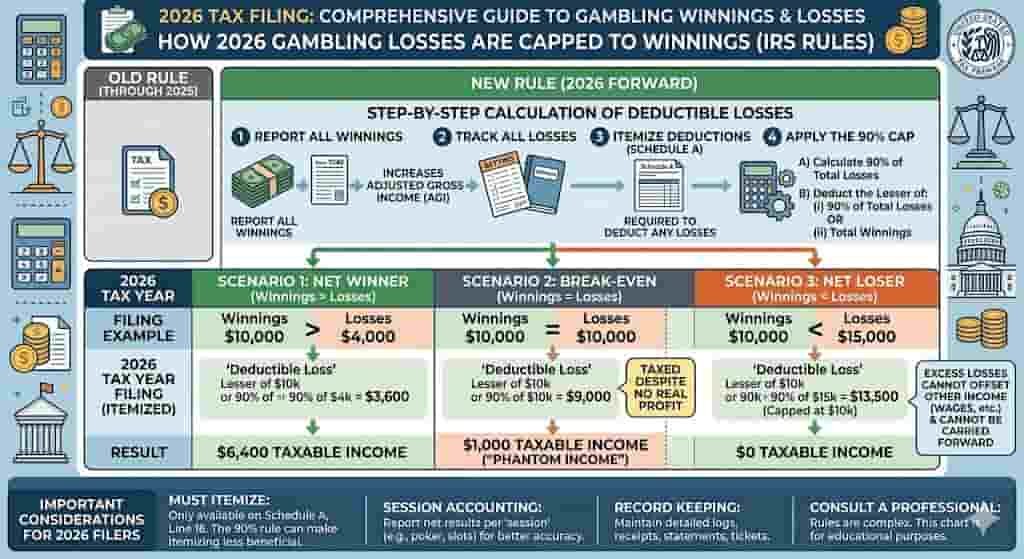
The most rigid rule in the book is that gambling losses capped to gambling winnings are the limit of your relief. Unlike business losses or capital losses in the stock market, you cannot use a “bad year” at the casino to lower your taxable income from your 9-to-5 job.
The Math of the Cap:
Imagine you are a sports bettor:
- Total Winnings for 2026: $15,000
- Total Losses for 2026: $20,000
- Deductible Amount: $15,000
- Unused Loss: $5,000 (This amount is “lost” forever; you cannot carry it forward to 2027).
This “cap” ensures that while the IRS shares in your success, they do not subsidize your losses.
2026 Updates: New Tax Law Gambling Losses Every Player Should Know
The tax landscape shifted significantly with the Tax Cuts and Jobs Act, and in 2026, we are seeing the full maturity of those changes. The new tax law gambling losses provisions have made it harder for “casual” players to deduct expenses.
Previously, some argued that “expenses” related to gambling (like travel) could be part of the loss. Now, for the casual player, the deduction is strictly limited to the money wagered and lost. Furthermore, the IRS has increased its focus on “Session Accounting.” This means you can’t just look at your year-end bankroll; you must track your wins and losses by individual “sessions” (a day at the track or a single sitting at a poker table).
Bulletproof Your Audit: Essential Record-Keeping Hacks for Gamblers
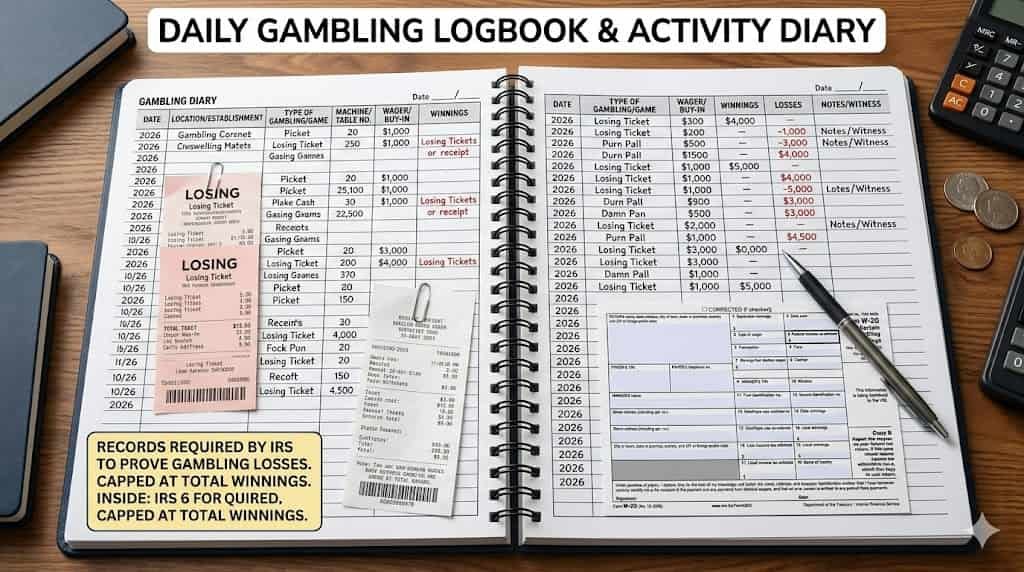
If you tell the IRS, “Are gambling losses tax deductible for me?” they will answer: “Show us the receipts.” Without a paper trail, your deduction will be disallowed in an audit.
The Gold Standard of Records:
- The Contemporaneous Diary: This is a fancy term for a real-time log. You should record the date, the specific game, the casino/app used, and the amounts won and lost.
- The “Win/Loss Statement”: Most modern casinos track your play via a loyalty card. At the end of the year, download your statement. Note: The IRS often views these as “supplemental” but not “primary” evidence. Your diary is still king.
- Physical Evidence: Keep your losing Keno tickets, discarded lottery scratch-offs, and bank statements showing ATM withdrawals at gambling locations.
Game-Specific Insights: How the Cap Rule Applies to Slots, Poker, and Sports
This is where GamblingHacks.net readers need to pay close attention. How you file depends on your “status.”
- The Casual Player: Reports wins as “Other Income” on Form 1040 and deducts losses on Schedule A. You cannot deduct “business expenses” like your trip to Las Vegas or your subscription to a sports handicapping service.
- The Professional Gambler: If you gamble for a living, you file Schedule C. Your gambling activity is treated as a business. This allows you to deduct travel, meals, and home office costs. However, the IRS has a very high bar for who qualifies as a “Pro.” You must demonstrate that you pursue gambling with “continuity and regularity” for the primary purpose of income.
Audit-Proof Your Return: How to Prove Your Losses to the IRS with Certainty
The IRS flags tax returns that look “unusual.” Here is how to stay off their radar:
- Avoid “Rounding” Numbers: If you report exactly $5,000 in wins and $5,000 in losses, it looks suspicious. Use exact figures (e.g., $5,142.50).
- Don’t forget the W-2G: If a casino sends you a W-2G, the IRS already has a copy. If you fail to report that specific win, you will get an automated “CP2000” notice (an under-reporting flag).
- State Tax Nuances: Be careful! While federal law allows deductions, states like Illinois, Michigan, and others have different rules. In some states, you pay tax on the gross win without any state-level deduction for losses.

Tax Efficiency Strategy: Legally Maximizing Your Gambling Loss Deduction in 2026
To get the most out of your gambling loss deduction, you should:
- Group your sessions: Understand how your state and the federal government define a “session” to minimize your reported gross income.
- Track “Non-Cash” Wins: If you won a tournament seat or a physical prize, get a fair market valuation immediately to ensure you aren’t over-reporting its value.
- Consult a Pro: If your winnings exceed $10,000, the cost of a CPA is usually much less than the tax savings they can find for you.
FAQs (Deep Knowledge Base)
Q1: Can I deduct my losses if I take the Standard Deduction?
No. This is the most common mistake. You must itemize. If you don’t have enough other deductions to justify itemizing, your gambling losses won’t help your tax bill.
Q2: What if I lost more than I won?
Your gambling losses capped to gambling winnings rule applies. You can reduce your gambling tax to zero, but you cannot create a “tax loss” to reduce other income.
Q3: Are “comps” (free rooms/meals) taxable?
Technically, yes. If a casino gives you a gift with significant value, it is considered a prize and should be reported at its fair market value.
Q4: Does the IRS track online sports betting?
Yes. Regulated US apps (FanDuel, DraftKings, etc.) report winnings to the IRS. Even if they don’t send you a form, they maintain digital records that the IRS can subpoena.
Conclusion: The Final Hack
The ultimate “hack” in gambling isn’t a secret betting system—it’s keeping more of what you win. By understanding that are gambling losses tax deductible only under strict itemization and that the new tax law gambling losses require better record-keeping, you put yourself ahead of 90% of other players. Protect your bankroll by treating your taxes as seriously as your bets.
For more expert guides on iGaming, casino strategies, and legal hacks, keep visiting GamblingHacks.net.